> ## Documentation Index
> Fetch the complete documentation index at: https://docs.bluprynt.com/llms.txt
> Use this file to discover all available pages before exploring further.
# Asset Dependency Engine
> One deterministic graph of every layer a token depends on.
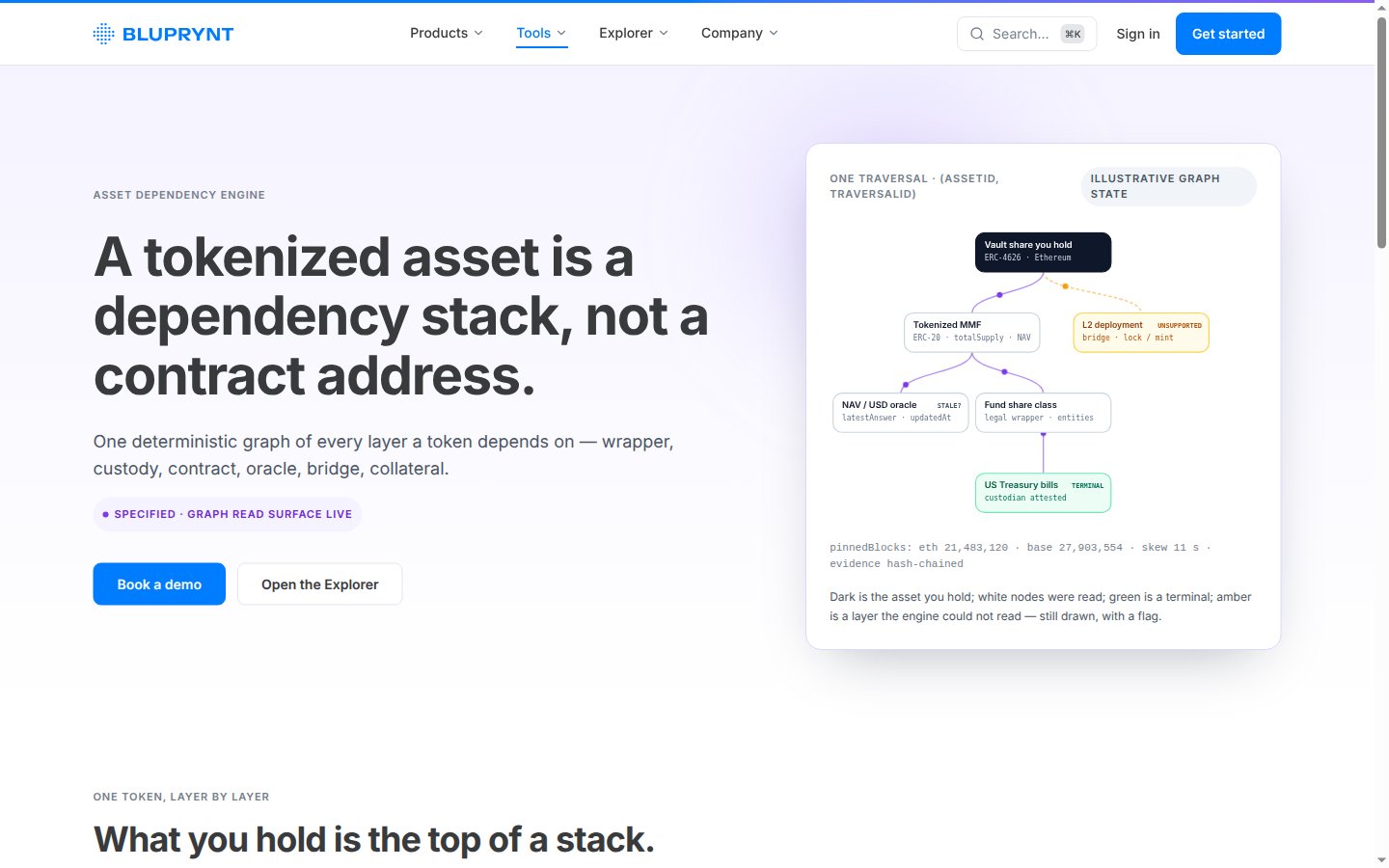
A tokenized asset is a stack, not a contract address. The Asset Dependency Engine maps everything under a token — vault, underlying token, oracle, bridge, legal wrapper and collateral — into one graph.
 ## How it reads a stack
The engine classifies each layer, resolves what sits under it, and reads it — recursively, up to **16 levels** deep. A branch ends only at native ETH, attested off-chain backing, or a plain ERC-20 read.
| Principle | What it means for you |
| - | - |
| **Deterministic** | The same asset at the same pinned blocks gives the same graph. Every traversal can be replayed. |
| **Unsupported is a node** | A layer the engine can't read still appears, flagged with a reason. Nothing is silently left out. |
| **Read-only inspector** | Explorer shows sealed graph states. It never recomputes a read in your browser. |
## What it doesn't do
* It doesn't guess a dependency it can't classify; it flags the node.
* It doesn't re-run on every block. Runs are manual, scheduled or replayed.
* It doesn't score risk. It shows the dependencies and leaves the judgment to you.
Open any asset in [Compliance Explorer](https://explorer.bluprynt.com) to see its graph.
This documentation is built and hosted on [Mintlify](https://mintlify.com), a developer documentation platform.
## How it reads a stack
The engine classifies each layer, resolves what sits under it, and reads it — recursively, up to **16 levels** deep. A branch ends only at native ETH, attested off-chain backing, or a plain ERC-20 read.
| Principle | What it means for you |
| - | - |
| **Deterministic** | The same asset at the same pinned blocks gives the same graph. Every traversal can be replayed. |
| **Unsupported is a node** | A layer the engine can't read still appears, flagged with a reason. Nothing is silently left out. |
| **Read-only inspector** | Explorer shows sealed graph states. It never recomputes a read in your browser. |
## What it doesn't do
* It doesn't guess a dependency it can't classify; it flags the node.
* It doesn't re-run on every block. Runs are manual, scheduled or replayed.
* It doesn't score risk. It shows the dependencies and leaves the judgment to you.
Open any asset in [Compliance Explorer](https://explorer.bluprynt.com) to see its graph.
This documentation is built and hosted on [Mintlify](https://mintlify.com), a developer documentation platform.